Robot Lawn Mower Without RTK Station: Best Pick for 2026
Almost every “wire-free” robot lawn mower sold in 2026 still needs a small thing planted in your yard: an RTK reference station, on a clear-sky pole, with a power run. It’s not as bad as burying 500 feet of perimeter wire, but it’s still hardware that has to live outside, get power, and aim at the satellite vault. If a tree blocks the sky over your most logical pole spot, you’re stuck.
There is exactly one robot lawn mower without an RTK station that I’d recommend for a residential half-acre — and it gets there with twin spinning LiDAR sensors instead of GPS. Here’s where it lands, where the trade-offs are, and how the price compares to the alternatives that still need that pole.
Why most “wire-free” robot mowers still need an RTK base station
Wire-free is doing a lot of work in marketing copy. Most “wire-free” robot mowers replace the buried perimeter wire with centimeter-accurate RTK GPS positioning, which requires a fixed reference station with line-of-sight to the sky. The station observes the same satellites the mower does and broadcasts corrections in real time, dropping accuracy from ~3 meters (consumer GPS) down to about 2 cm. That’s fine enough to follow a flower-bed edge.
The catch is the station itself. It has to:
- Sit somewhere with a clear sky view (no overhanging canopy)
- Have a power source within cable reach
- Stay stationary, ideally on a roof bracket or yard pole
For a typical suburban lot with mature trees, finding that spot is annoying. For an HOA-restricted property where you can’t add a roof antenna, it can be a deal-breaker. The Mammotion LUBA 3 AWD line is explicitly “Tri-Fusion”: LiDAR + NetRTK + AI Vision, with the RTK leg required for positioning. Husqvarna’s wire-free Automower NERA range likewise relies on satellite-based EPOS positioning, which needs the satellite link to work.
Takeaway: when a listing says “wire-free,” check whether there’s still a reference station or external satellite anchor in the box. Most current units have one.
What “robot lawn mower without RTK station” actually looks like
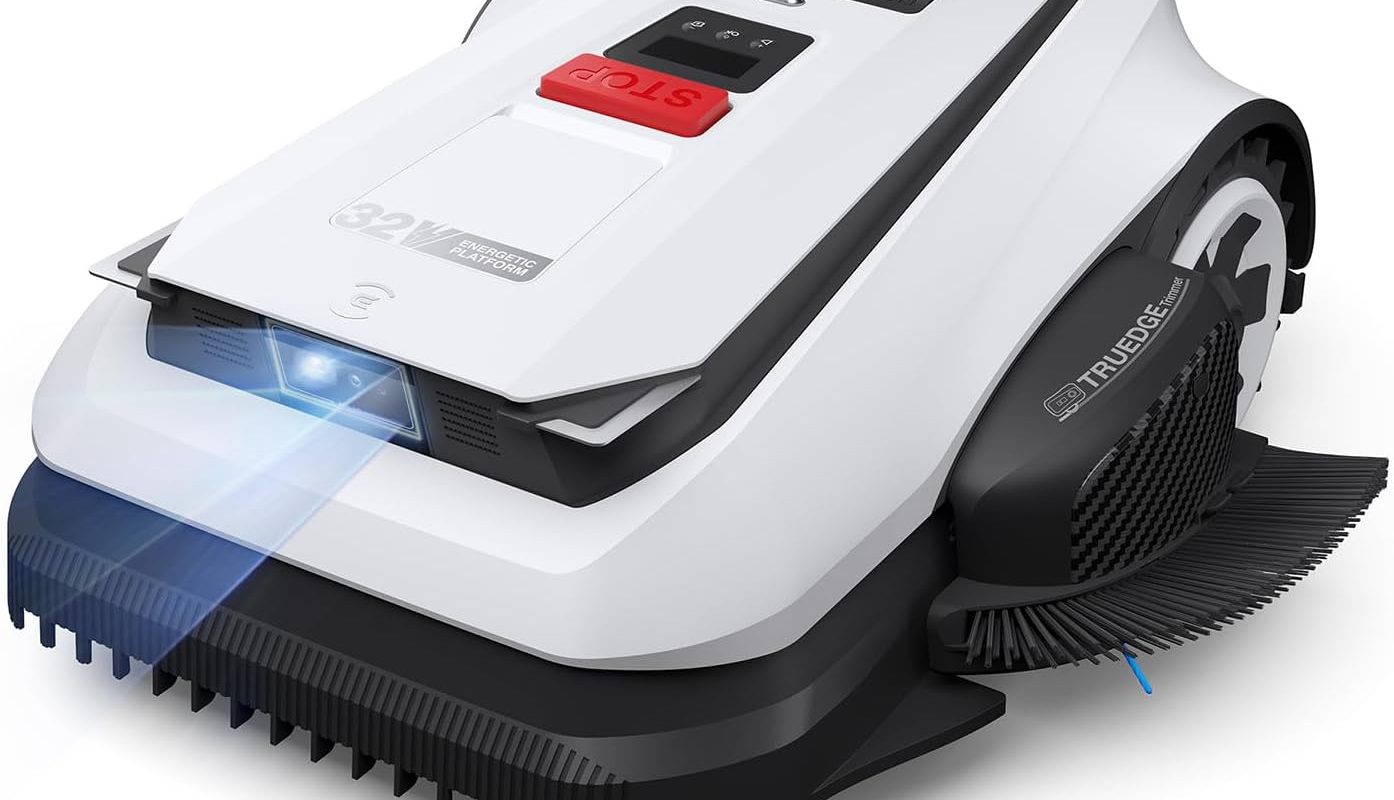
The robot lawn mower without RTK station I’d actually buy for under $2,000 is the ECOVACS Goat A2000 LiDAR PRO. Its trick: HoloScope 360° dual-LiDAR with AI Vision and 3D-ToF, which together deliver about 2 cm positioning without any external reference station — even under trees, near fences, or in shaded areas where GPS mowers lose signal.
In plain terms: the mower carries its own positioning hardware. There’s no pole. There’s no antenna to mount. You unbox it, walk the perimeter once with the mower (or do a remote-control map) and it remembers the boundary.
Two things make this matter for buyers:
- No site survey — RTK stations need a clear-sky spot, which is the single most common gotcha in robot-mower setup. LiDAR-only doesn’t care
- Works under canopy — heavy tree cover that breaks RTK doesn’t break LiDAR; the sensors see the actual ground rather than relying on satellites
The Goat A2000 launched at $2,000 MSRP in February 2026 and is now $1,699 on Amazon as the standard price after its second-ever discount — that’s the price you’d actually pay today.
ECOVACS Goat A2000 LiDAR PRO: the specs that matter
The numbers worth knowing before you buy, taken from the manufacturer:
- Coverage: up to 1/2 acre (~21,780 sq ft) on a single map
- Slope: 50% (27°) climbing capability on the 32V platform
- Throughput: 400 sq m/hour — meaning a 0.5-acre cut runs roughly 5 hours per pass
- Obstacle avoidance: AI Vision recognizes 200+ obstacle types and stably avoids objects at just 1.97 inches
- Cutting: dual-blade disc, 3000 rpm (33% faster than the previous G1), adjustable height
- Edge cutting: built-in TruEdge trimmer — a separate line that handles the flush perimeter most robot mowers can’t reach
- Battery: 3.0 Ah, ~50-minute fast recharge
- Waterproofing: hose-down safe
The TruEdge trimmer is the spec that gets least attention but probably matters most over a season. Standard robotic mowers leave a 2-3 inch strip of uncut grass along every wall and bed because the blade disc is inside the wheelbase. The Goat A2000’s trimmer is a separate consumable line (refills sold by ECOVACS as the Trimmer Line accessory) that cuts flush. Saves you the weekly weed-whacker pass.
Takeaway: spec-for-spec the Goat A2000 is closer to Husqvarna premium-tier than to budget wire-free competitors, with the LiDAR-only navigation being the actual differentiator.
How $1,699 compares to RTK-based alternatives
Direct price-feature comparison against the wire-free units I’d actually shop. All prices from each maker’s own listing or major retailer:
| Mower | Price | Wire-free | Needs RTK station? | Coverage |
|---|---|---|---|---|
| ECOVACS Goat A2000 LiDAR PRO | $1,699 | Yes | No (LiDAR-only) | 1/2 acre |
| Mammotion LUBA 3 AWD 1500H | $2,099 | Yes | Yes (NetRTK) | 0.37 acre |
| Mammotion LUBA 3 AWD 3000 | $2,499 | Yes | Yes (NetRTK) | 0.75 acre |
| Husqvarna Automower 415X | ~$1,999 | No (wire) | N/A — uses wire | 0.4 acre |
Reading the table: the Goat A2000 is the only LiDAR-only entry, and at $1,699 it’s also the only sub-$2,000 wire-free option that doesn’t need a station. The Mammotion is the closest direct competitor on capability but costs $400-$800 more depending on coverage class and brings the RTK dependency back. The Husqvarna 415X is the long-trusted name but is wire-bound, so it doesn’t compete on the “no install hassle” axis.
Takeaway: if “no RTK station” is a hard requirement (HOA, dense tree cover, or you just don’t want a pole), the Goat A2000 is the only credible 2026 pick.
Where the Goat A2000 falls short
This is not a perfect machine. The honest cons, drawn from buyer feedback on its Amazon listing and the product’s own page:
- Premium price — $1,699 list is 2-3× wire-free budget competitors, even before you account for the $1,449 deal price the unit has touched
- Documented early-life failures — at least one verified Amazon reviewer hit an “Error 601: left wheel not working” fault on the first mow
- Small review sample — 49 verified ratings (4.4-star average per the product listing) versus Husqvarna’s decade of accumulated field data
- Only 1/2-acre coverage — 3/4 acre or larger lots need to step up to the Goat A3000 LiDAR PRO at higher MSRP, or look outside ECOVACS
- TruEdge line is consumable — the trimmer eats line over a season; replacement rolls are sold separately as the GOAT Trimmer Line accessory
If any of those are dealbreakers — especially the early-life error reports — the safer move is Husqvarna at the same coverage tier with the boundary-wire install.
Coverage and slope: what 1/2 acre really means
The Goat A2000’s 1/2-acre rating is 21,780 sq ft on a single map. That covers roughly a 50×100 ft front yard plus a 60×80 ft back, with margin — i.e. the median US single-family suburban lot.
What it covers:
- Standard suburban front + back lawns
- Side-yard strips wide enough for its 19.6×15.4-inch chassis
- Slopes up to 50% (27°), which is genuinely steep — most $1,000 mowers cap at 35%
What it doesn’t cover:
- Rural lots above 0.5 acre — those need the A3000 or the Mammotion LUBA 3 AWD 3000H ($2,499)
- Continuous heavy-canopy yards where even LiDAR struggles (LiDAR sees ground; it does not see through total dark)
- Lots with severe slope transitions above 50% — agricultural or hillside properties
For a normal half-acre suburban lot with mature shade trees, the Goat A2000’s LiDAR-first approach is probably the most “set and forget” wire-free experience you can buy in 2026.
Where to go from here
The cheapest robot lawn mower without RTK station in 2026 is the ECOVACS Goat A2000 LiDAR PRO at $1,699 — the only LiDAR-only wire-free unit under $2,000, and the only credible pick if you can’t or don’t want to mount an external satellite antenna. The trade-offs are real: thin review sample, premium price, and a consumable trimmer line. But for a half-acre suburban yard with shade trees and an HOA that frowns on extra hardware, those are the right trade-offs.
If your yard fits under 1/2 acre and you’re tired of mowing yourself, the Goat A2000 is on Amazon at $1,699. If you need 3/4 acre or more, look at the A3000 or the Mammotion LUBA 3 AWD 3000H instead — both expand coverage at the cost of bringing RTK back into the picture.
FAQ
what is the best robot lawn mower without an rtk station
The ECOVACS Goat A2000 LiDAR PRO is currently the only major robot lawn mower under $2,000 that runs entirely on onboard LiDAR with no external RTK reference station. It rates for 1/2-acre coverage, handles 50% slopes, and uses AI Vision plus dual LiDAR for positioning under tree cover where GPS-based competitors lose signal.
do wire-free robot mowers always need an rtk station
Most current “wire-free” models do — Mammotion’s LUBA 3 AWD line, for example, uses tri-fusion navigation that requires NetRTK as one of its three positioning legs. LiDAR-only units like the ECOVACS Goat A2000 are the exception, not the rule. Always check the spec sheet for “reference station required” before assuming.
how accurate is lidar-only positioning compared to rtk
Both target the 2 cm range in optimal conditions. ECOVACS lists “~2 cm positioning” for the Goat A2000’s HoloScope dual-LiDAR system on its own product page. Real-world accuracy can drop slightly in low-feature open spaces where there’s nothing for the LiDAR to lock onto, but in typical suburban yards with fences, beds, and trees as anchors, the two technologies are competitive.
how big a lawn can the ecovacs goat a2000 mow
Rated for up to 1/2 acre (about 21,780 sq ft) on a single map. Throughput is 400 sq m/hour, so a full half-acre cut takes roughly 5 hours per pass. For 3/4 acre or more, ECOVACS sells the larger Goat A3000 LiDAR PRO; Mammotion’s LUBA 3 AWD 3000 covers similar acreage at $2,499.
is the ecovacs goat a2000 worth $1,699
For a buyer with a half-acre or smaller lot who wants no RTK station and no buried wire, yes — at the current Amazon price it’s the only unit that delivers that combination. For buyers willing to add an RTK pole (Mammotion) or run perimeter wire (Husqvarna), there are cheaper paths to a working robot mower, but neither matches the “drop and go” simplicity of LiDAR-only navigation.
Leave a Reply