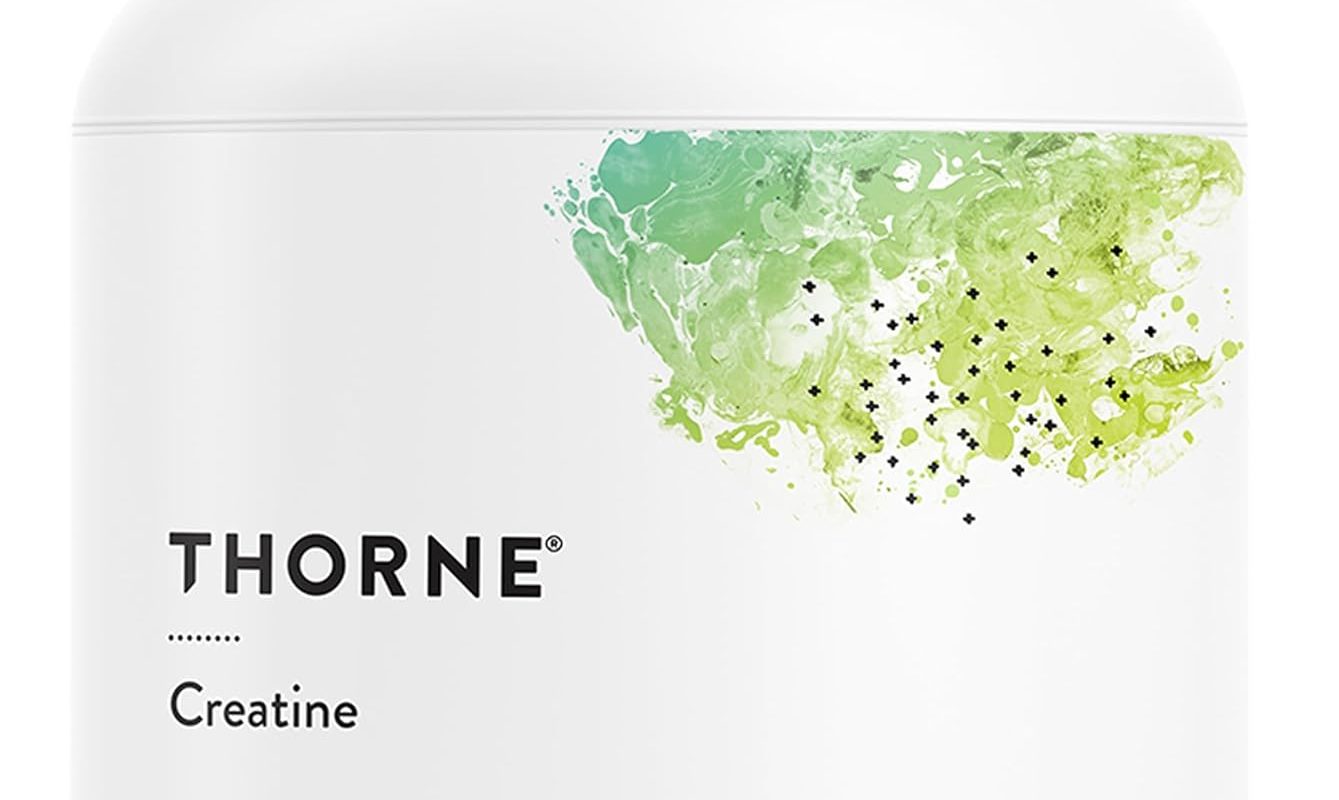
Best Creatine for Adults Over 50: Why Thorne Wins in 2026
If you’re in your 50s or 60s and thinking about creatine for the first time, the decision feels different than it did for the 25-year-old version of you. You’re not chasing a one-rep max. You care about strength loss, fall risk, brain fog, and not buying a $44 tub of powder that turns out to be cut with lead. This post walks through the best creatine for adults over 50 in 2026 — what to look for, why third-party certification matters more than it did a decade ago, and how Thorne Creatine stacks up against the cheaper brands you’ve seen on Amazon.
Why the best creatine for adults over 50 looks different from what younger lifters take
Younger lifters generally pick creatine on price-per-serving and brand recognition. That math changes after 50 for two reasons.
First, the cognition research has moved. A 2024 systematic review in Frontiers in Nutrition found that creatine monohydrate supplementation was associated with improvements in memory, attention, and processing speed across adult populations, with strongest effects in older adults (Frontiers in Nutrition, 2024). A more recent 2025 systematic review focused specifically on aging found 5 of 6 included studies reported positive effects on memory and attention in older adults (Nutrition Reviews / Oxford Academic, 2025). That’s a different value proposition than “lift heavier.”
Second, what’s IN the powder matters more. Younger users tolerate trace contaminants more forgivingly because their kidneys, liver, and bone reservoirs all have more headroom. After 50, you generally don’t want a daily supplement that’s been third-party tested only for “is this actually creatine” — you want one that’s tested lot-by-lot for heavy metals and banned substances. That narrows the field fast.
How Thorne Creatine is sourced and certified
Two certifications matter for the over-50 buyer, and Thorne has both:
- Creapure source. The creatine itself is made by Alzchem at a dedicated facility in Germany, with every batch tested by HPLC to confirm purity of at least 99.9% creatine monohydrate, and analyzed for heavy metals including lead, mercury, arsenic, and cadmium (Creapure / Alzchem). Independent third-party testing of Creapure-based products has confirmed non-detectable levels of all four heavy metals (Tamara Rubin Lab Test, 2025).
- NSF Certified for Sport. This is the strict version of NSF certification — every production lot of a certified product is tested against a list of 290+ banned substances drawn from WADA’s prohibited list (NSF Certified for Sport). Thorne Creatine’s listing is public, showing 7 individually-tested lot numbers and a 453 g package size at 5 g per serving (NSF Certified for Sport listing).
For a retail trust signal, the Mayo Clinic Store carries the exact same 90-serving Thorne Creatine product at $44, marketed under “Focus & Cognition” and “Sports Performance” categories (Mayo Clinic Store). It is fairly unusual for a tertiary care hospital’s retail arm to stock a creatine product. It’s not a clinical endorsement, but it is a procurement signal.
What the 2025 research actually says about creatine and cognition after 50
The headlines around creatine for brain health have gotten loud, so it’s worth grounding what the evidence actually supports.
The 2025 Nutrition Reviews systematic review pooled studies of creatine supplementation in healthy older adults and found that 5 of 6 reported positive cognitive effects, mostly in memory and attention domains. The GRADE assessment rated certainty of evidence for memory function as moderate — meaning a reasonable level of confidence — while certainty for processing speed, executive function, and overall cognition was rated low (Nutrition Reviews, 2025).
In plain English: the strongest evidence is for memory. The other effects are real candidates but not yet confirmed at the same level. There is also early pilot work on creatine in Alzheimer’s populations testing feasibility and brain creatine uptake (Alzheimer’s & Dementia: TRCI, 2025), but that’s not yet a clinical claim you can make as a buyer.
What this means practically: if you’re a 55-year-old who lifts twice a week and notices a touch more word-finding friction than five years ago, creatine is a defensible thing to try — at the standard 5 g/day dose for at least 8–12 weeks before judging it. It is not a treatment for cognitive impairment, and nobody honest is selling it as one.
The price gap: Thorne vs Optimum Nutrition vs Nutricost
This is the conversation that decides most purchases. Thorne is roughly 2–3× the price per serving of the budget brands. Here is what you are actually paying for, head to head:
| Product | Servings | Dose | Source / certification | Approx. price |
|---|---|---|---|---|
| Thorne Creatine (90 servings) | 90 | 5 g | Creapure (Germany), NSF Certified for Sport | $44 (Mayo Clinic Store) |
| Optimum Nutrition Micronized Creatine (120) | 120 | 5 g | Source not publicly disclosed; in-house testing | varies (Amazon listing) |
| Nutricost Creatine Monohydrate (100 servings) | 100 | 5 g | Source not publicly disclosed; in-house testing | varies (Amazon listing) |
On a per-serving basis, Thorne is around $0.49 per 5 g dose. Optimum Nutrition and Nutricost both run substantially lower per serving but neither publicly discloses whether their creatine is Creapure or sourced from one of the lower-cost Chinese suppliers, and neither carries NSF Certified for Sport at the same product-line level.
For a 30-year-old, “in-house tested” is usually fine. For a 60-year-old taking the powder every day for a decade, the gap between “the company tested it” and “an external accredited body tests every production lot for 290 banned substances” is what you are paying $0.30/serving extra for.
Where Thorne isn’t the right pick
This is a review, not an ad. There are real reasons to skip Thorne:
- You’re price-sensitive and not over 50. A 28-year-old recreational lifter with no medical concerns is overpaying. Optimum Nutrition or Nutricost are both perfectly defensible.
- You want flavoring, blends, or pre-workout. Thorne sells a single-ingredient unflavored powder. That is by design — but if you want a creatine-plus-caffeine-plus-beta-alanine stack, look elsewhere.
- You don’t lift. A 2024 Nutrients review on creatine in older adults and clinical populations notes that benefits are markedly larger when combined with resistance training (Nutrients / PMC, 2024). Supplementing without lifting still does something, but you’re not getting most of the value.
- You want to buy direct. Thorne.com customer service has a documented pattern of refund and delivery complaints on third-party review platforms. Buying through Amazon sidesteps that.
Buying tips for first-time creatine users over 50
A few practical notes if you’ve never used it before:
- Skip the loading phase. The classic 20 g/day-for-5-days protocol was designed to saturate muscles fast for athletic performance. For most over-50 users, 5 g/day for 3–4 weeks reaches the same saturation with less stomach upset.
- Take it with a meal that has carbs. Insulin transports creatine more efficiently into muscle. Coffee + breakfast works.
- Expect mild bloating in week one. Your muscle cells are pulling in water — that’s the mechanism of action. It resolves.
- Drink more water than usual. Creatine increases intracellular water demand. This isn’t a kidney warning — it’s a hydration reminder.
- Give it at least 8 weeks before judging it. Strength changes show up in 4–6 weeks. Cognitive changes, when they show up, are subtle and slower.
If you want the convenience of Amazon’s delivery and return windows along with Thorne’s certifications, the Amazon listing for Thorne Creatine is here — the product page on stowelabs.dev has the affiliate link to Amazon along with the full specifications.
Conclusion
The best creatine for adults over 50 in 2026 isn’t determined by price-per-serving — it’s determined by source disclosure, lot-level third-party testing, and how much daily-supplement risk you’re willing to inherit. Thorne Creatine costs more because the Creapure source is disclosed, every NSF-certified lot is tested against 290 banned substances, and Mayo Clinic’s retail store carries it. If that buys you peace of mind for $0.30 a day extra over Nutricost, it’s a defensible upgrade. If you’re younger or cost-driven, the budget brands are not unsafe — they’re just less verified. Either way, pair the powder with resistance training and give it eight weeks before deciding it works.
FAQ
Is creatine safe for adults over 50?
For generally healthy adults with normal kidney function, yes. The 2024 Nutrients review on creatine monohydrate in older adults and clinical populations concluded that 3–5 g/day is well-tolerated and the side-effect profile in older adults is comparable to younger adults (Nutrients / PMC, 2024). If you have chronic kidney disease, talk to your physician before starting.
Does creatine really help memory in older adults?
Recent evidence is leaning yes for memory specifically. The 2025 Nutrition Reviews systematic review found 5 of 6 included studies reported positive effects on memory in older adults, with the GRADE certainty for memory rated moderate (Nutrition Reviews, 2025). It’s not a cure for cognitive decline, but it’s a defensible adjunct for healthy aging.
Why is Thorne three times the price of generic creatine?
You’re paying for source disclosure (Creapure, made in Germany) and certification cost (NSF Certified for Sport tests every production lot against 290+ banned substances). The molecule is the same. The verification of what’s actually in the bottle is what differs.
How long until I notice anything?
Strength changes typically show up in 4–6 weeks with consistent training. Any subjective cognitive shifts are slower and more subtle — give it at least 8–12 weeks at 5 g/day before deciding whether to continue.
Do I need to cycle off creatine?
No. The cycling protocols from the early-2000s bodybuilding world were never grounded in evidence. Daily 3–5 g indefinitely is the supported protocol for most users.
Leave a Reply